Risk management system
Credit Saison Co., Ltd. (the “Company”) considers the risks surrounding the Company and each Group company (including overseas bases and overseas affiliated companies) to be an important management issue for achieving sustainable growth and enhancement of corporate value as a “GLOBAL NEO FINANCE COMPANY—A global comprehensive life services group with finance at the core—.”
Taking changes in business characteristics and changes in the external environment into consideration, the Company assesses and evaluates risks and takes action to address them according to risk characteristics. We also regularly check action taken and make revisions where necessary. Furthermore, as we expand our business globally, we take factors such as differences in regulatory environments and commercial practices into consideration when managing risks.
The Company has established the Risk Management Committee, which works with each business department to assess and evaluate major risks, check action plans, and monitor action taken. The committee reports important matters to the Board of Directors where necessary.
In addition, we work to ensure financial soundness through use of the risk capital management (RCM) method to build appropriate financial foundations where necessary.
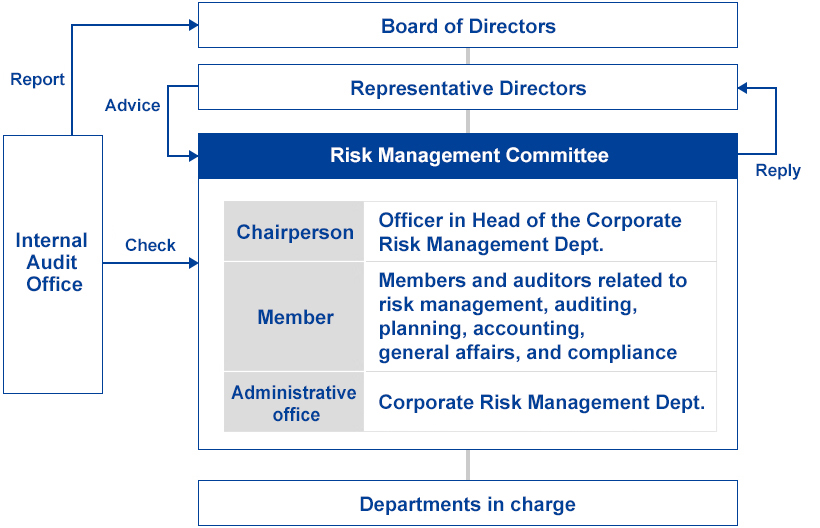
Risk management based on the "Three Lines of Defence" model
We have organized the division of roles for risk management based on the "Three Lines of Defence" model, to clarify roles and responsibilities for addressing risks associated with business operations.
While cooperating with each other, each line of defence ensures independence and objectivity according to their respective role, helping prevent the materialization of risk, minimize the impact in the event of materialization and bring about continuous improvement.
First line of defence (Business departments: Risk owners)
The first line of defence is responsible for assessing risks in routine operations, developing and operating necessary controls, rectifying issues, and reporting in a timely manner.
Second line of defence (Administrative departments such as risk management and compliance departments)
Administrative departments such as risk management and compliance departments develop the companywide framework (policies, regulations, procedures, etc.) and provide advice and support to business departments. The second line also monitors the status of the first line's initiatives and encourages improvement where necessary.
Third line of defence (Audit Dept.)
The Audit Dept. audits the effectiveness of business operations, internal controls and risk management processes, identifies any issues and makes recommendations for improvement from an independent standpoint as the Internal Audit Office.
Risk management processes
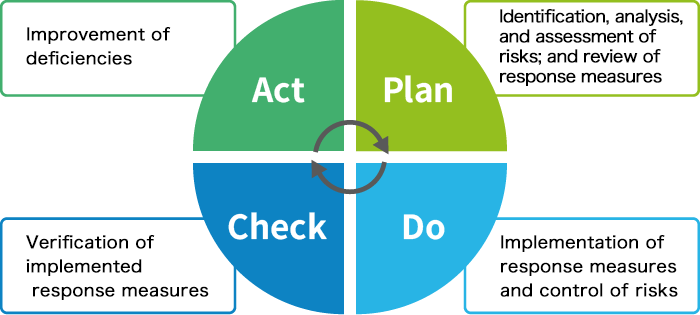
We operate risk management processes based on the PDCA cycle as our basic risk management approach. In managing the risks surrounding the Company and each group company, we assess, evaluate, address and monitor risks as a series of processes and make ongoing revisions in light of changes in the external environment and business envirornment.
Major risks
We organize risks that might impact business activities and assess them through the risk assessment process.
Risks that need to be managed are classified into multiple categories according to their nature and characteristics, and we take action necessary to address them based on confirmation of the status and importance of risks.
Risk categories
| Management strategy risk | Credit risk |
| Market risk | Funding liquidity risk |
| Administrative risk | Information security risk |
| System risk | Compliance risk (including legal risk) |
| Human risk | Business continuity risk |
| Reputational risk |
Top risks
In managing risks that might impact our business operations, our Risk Management Committee leads discussions on risk domains that are especially noteworthy for management and priorities to be addressed, taking factors such as the evaluations of the departments in charge of the risks and hearings into consideration.
Based on the information confirmed through such discussions, the committee continuously checks the direction of action being taken to address risks and the state of progress and reports to the Board of Directors where necessary.
The committee also make appropriate revisions to the information that needs to be checked as a priority in light of changes in the business environment and the status of risks.
Overview of risks in main businesses
We disclose risks associated with the Credit Saison Group's main businesses in the Business and Other Risks section of our securities report. The information on this page is the same as the information contained in the securities report.
(1) Risks related to management strategy, business portfolio, and global expansion
① Risks related to the transformation of the business portfolio and capital allocation
Guided by its medium-term management vision, the Credit Saison Group is pursuing growth strategies centered on the Payment Business Segment, Finance Business Segment, and Global Business Segment. In the implementation of these initiatives, if the business portfolio is not reviewed or capital allocation decisions are not made in a timely and appropriate manner, the Group's performance, financial position, and corporate value may be affected by factors such as missed investment opportunities in growth fields, delays in the review of low-profitability businesses, investment losses, or impairment losses.
The Group, through the activities of its Board of Directors and other bodies, reviews its business portfolio and capital allocation as necessary, taking into account the business environment and the status of investment projects.
② Risks related to the Global Business Segment
The Group operates lending and investment businesses mainly in India, Southeast Asia, and Latin America.
While the growth potential in these regions is expected to be high, businesses in these regions tend to be more significantly affected by economic fluctuations, changes in political and social conditions, laws and regulations, monetary policy, and market structures, and other factors than businesses in Japan. Uncertainty in their business operations also tends to be relatively higher. Under these conditions, if there is an economic downturn, interest rates or foreign exchange rates fluctuate, the funding environment deteriorates, the performance of business partners or investees worsens, or the collection environment deteriorates, the Group's performance and financial position may be affected by factors such as higher funding costs, increases in credit-related expenses, recognition of investment losses, additional capital injections, or expenses associated with the restructuring of or withdrawal from businesses.
The Group works to reduce these risks by continuously monitoring the performance, asset quality, regulatory trends, and liquidity position of its operating companies in each country. It also strengthens its portfolio management by country and product and enhances local governance through its IHQ (International Headquarters).
③ Risks related to affiliates, investees, and business partners
The Group expands its customer base, range of products and services, and business domains by collaborating with its affiliates, investees, and business partners. However, if important related parties experience the deterioration of their performance, governance failures, failures to achieve business plans, changes in contract terms, or the termination of partnerships, the Group's performance and corporate value may be affected by factors such as the contraction of customer acquisition channels, a decrease in transaction volume, a decline in related revenues, or a decrease in equity-method income or investment income.
The Group regularly reviews the performance, governance, and risk management status of affiliates. It monitors the post-investment performance of investees and the progress in their achievement of business plans. The Group also regularly reviews the transaction volume, transaction terms, and operational status of its business partners. The Group revises its response policies as necessary according to the importance of each matter.
(2) Risks related to the external environment
① Impact of changes in the economic environment, interest rates, exchange rates, geopolitical factors, etc.
The Group engages in business activities both domestically and internationally and is affected by factors such as economic downturns in Japan and overseas, prolonged inflation, fluctuations in interest rates and exchange rates, heightened geopolitical tensions, and changes in trade policies. If these changes exceed expectations, they may spill over into the credit risk, market risk, liquidity risk, and other risks described below, and may affect the Group's performance and financial position.
The Group continuously monitors macroeconomic conditions, interest rates, exchange rates, and country-specific risk trends in Japan and overseas, and reviews its product operations, credit policies, investment policies, and funding policies in a timely manner.
② Impact of competition with other companies
In the Payment Business Segment, competition to acquire members and merchants is intensifying due to factors such as the diversification of payment methods, including code-based payments, smartphone payments, and other payment methods, the entry of companies from other industries and technology companies, and competition to retain customers by leveraging points programs and customer bases. If this competition intensifies further, the Group's profitability may be affected by factors such as slower growth in shopping transaction volume, lower merchant fee rates, and increases in member acquisition costs and point-related expenses.
In the Finance Business Segment, competition with various financial institutions continues across finance-related businesses, including the credit guarantee business and real estate finance, in areas such as transaction terms, acquisition of projects, development of business partners, and service quality. If this competition intensifies further, the Group's profitability may be affected by factors such as declines in lending yields or guarantee fee rates and decreases in transaction opportunities.
In the Global Business Segment, competition in lending and investment businesses operated in India, Southeast Asia, Latin America, and other regions may intensify with local banks, non-bank financial institutions, fintech companies, and global players from overseas. If intensifying competition results in increased competition for high-quality customers, declines in lending yields, increases in the cost of acquiring investment projects, or longer investment recovery periods, the Group's profitability and growth potential may be affected.
The Group works to maintain and enhance its competitiveness through measures in each business segment. In the Payment Business Segment, this includes shifting to affluent customers, corporations, and small and medium-sized businesses and expanding its customer base of high-activity, high-spend customers. In the Finance Business Segment, the Group is digitalizing operations, improving operational efficiency, and strengthening proposal capabilities. In the Global Business Segment, it is designing products suited to the characteristics of each country and region, digitalizing business processes, and strengthening governance through its IHQ.
③ Impact of regulatory and legislative changes
The Group is subject to the Companies Act, the Installment Sales Act, the Money Lending Business Act, the Banking Act, the Financial Instruments and Exchange Act, the Insurance Business Act, the Act on the Protection of Personal Information, the Act on Prevention of Transfer of Criminal Proceeds, the Act against Unjustifiable Premiums and Misleading Representations, consumer protection laws and regulations, and other laws and regulations in Japan and overseas, as well as guidelines issued by supervisory authorities and self-regulatory rules established by industry associations. If these legal systems, supervisory policies, self-regulatory rules, or other requirements are newly established or amended, or if their interpretation changes or their application becomes stricter, the Group may need to review areas such as card solicitation, merchant management, credit operations, loan collection, guarantee screening, advertising representations, identity verification, management of outsourced operations, management of overseas subsidiaries, data utilization, and system responses. This may affect the Group's performance and financial position through factors such as additional system investments and increases in operating costs, changes to products and services or business flows, and restrictions on the provision of certain services. In particular, in emerging markets, changes in regulations or revisions to regulatory practices may have a relatively significant impact on the business environment.
The Group has established a system for understanding trends in the enactment and amendment of laws and regulations and changes in supervisory policies through supervisory authorities, industry associations, and other channels, and for reviewing internal rules, business flows, product design, and systems as necessary.
④ Impact of climate change
The Group recognizes that climate change is an important issue that has a broad impact on the global environment, the economy and society. If transition risks associated with tighter regulations, higher carbon pricing, changes in the business structures of business partners, changes in consumer behavior, and other factors, as well as physical risks associated with extreme weather, wind and flood damage, and other events, materialize, they may affect the Group's performance and financial position over the medium to long term through factors such as increases in credit costs, declines in asset values, increases in operating costs, and a decline in social trust.
Through the activities of its Sustainability Promotion Committee and the Climate Change Strategy Promotion Working Group, the Group is working to identify climate change-related risks and opportunities, conduct scenario analyses, assess their impact on its investment and loan portfolio, and enhance its disclosure of information.
(3) Financial risks
① Liquidity risk (Fund procurement risk)
The Group mainly procures funds by borrowing from banks and other financial institutions and also by issuing securities such as corporate bonds and commercial paper (CP) in capital markets. Since the Group has a substantial amount of short-term debt with maturities of one year or less, such as short-term borrowings and CP, as well as the current portion of long-term liabilities that are scheduled to be repaid within one year, if liquidity risk increases due to factors specific to the Group, such as deterioration in business results or a downgrade of its credit rating, or external factors, such as an economic or financial crisis or a natural disaster, this may have a material impact on the Group's performance and financial position.
The Group strives to reduce liquidity risk by maintaining a certain percentage of long-term, fixed-rate funding, establishing commitment lines and other means of accessing supplemental liquidity, diversifying its funding methods through the issuance of corporate bonds, securitization of receivables, and other means, and staggering redemption dates.
② Market risk
The Group holds investment assets such as listed and unlisted stocks, investment funds, bonds, real estate, and real estate funds. The Group also uses variable interest rates for part of its financing and is exposed to exchange rate fluctuation risks associated with overseas businesses. If the market prices of stocks, bonds, real estate, or other assets decline, or if interest rates or exchange rates move unfavorably, this may affect the Group's performance and financial position through mechanisms such as loss on valuation of securities, fluctuations in gains and losses on investment funds, loss on valuation related to real estate, increases in interest expenses on funding, and foreign exchange losses.
Based on risk capital management (RCM) and asset and liability management (ALM), the Group establishes investment policies and limits, conducts preliminary screening when acquiring securities and derivatives, and conducts ongoing monitoring, and, as necessary, implements hedging measures and reviews funding terms. The Group manages market risk from both short-term and medium- to long-term perspectives at meetings of the Board of Directors and the ALM Committee.
③ Credit risk
The Group holds credit card receivables, lease receivables, real estate finance receivables, overseas lending receivables, and other receivables. The Group also has guaranteed payables associated with its credit guarantee business operations. If repayments or collections are not made in accordance with contractual terms due to the deterioration of economic conditions in Japan or overseas, changes in employment or income conditions, the deterioration of the real estate market, increases in delinquency rates in specific regions or segments, increases in fraudulent use, or other factors, this may affect the Group's performance and financial position through mechanisms such as increases in credit-related expenses, increases in payments under guaranteed payables, and shortfalls in collections upon the disposal of collateral.
Based on various rules related to credit risk management, the Group manages credit limits and credit information, and conducts ongoing credit management, while continuously monitoring the status of its receivables portfolio through receivables management meetings and other means. In addition, the Group continuously reviews its credit screening models and enhances its collection strategies. In the credit card eligibility screening process, the Group uses machine learning models to identify applicants who require a careful evaluation of their credit, thereby improving credit screening accuracy. To prevent unauthorized use of cards, the Group uses rule-based detection as its core approach, while reviewing and enhancing its detection logic in response to changes in suspicious transaction patterns.
In the Global Business Segment, in addition to credit risk management by overseas subsidiaries, the Group is developing a cross-border credit management structure centered on India and Singapore, and it monitors the status of receivables in each country through monthly global receivables management meetings and other means.
In addition to these initiatives, the Group records necessary allowances for doubtful accounts based on the credit status of debtors and the value of collateral.
④ Provision for loss on interest repayment
The Group may receive refund claims from customers for portions of interest received in the past in Japan that exceeded the interest rate cap set by the Interest Rate Restriction Act. If repayment claims increase beyond expectations due to significant changes in the economic environment, increases in the number of claims or processing unit costs, changes in the interpretation of laws and regulations, or other factors, this may affect the Group's performance and financial position through a temporary increase in expenses.
The Group continuously reviews its estimate of provisions based on past results, recent trends in claims, and the external environment.
⑤ Impairment of goodwill
The Group prepares its consolidated financial statements in accordance with IFRS. Under J-GAAP, goodwill is amortized systematically, which means that, as time passes, the balance of goodwill decreases and the risk of impairment loss also diminishes. However, under IFRS, goodwill is not amortized periodically, which means that the risk of impairment loss persists into the future. Each time goodwill arises from M&A or similar activities, the balance of goodwill increases, and the recognition of impairment losses may impact the Group's performance and financial position.
The Group sets investment limits based on RCM to establish mechanisms for avoiding excessive risk. In addition, supervisory divisions and specialized departments hold deliberations on the appropriateness of acquisition prices at the investment stage, follow up on investments to ensure achievement of income and expenditure plans, and regularly monitor the management environment of investees.
(4) Operational risks
① Information security and cybersecurity risks
The Group holds and operates various information assets, including credit card member information, as well as core systems, and it is important to ensure their confidentiality, integrity, and availability. Information leakage, data falsification, system outages, or service unavailability may occur due to cyberattacks from outside the Group, ransomware, unauthorized access, malware infections, breaches through outside contractors or cloud services, delays in responding to vulnerabilities, unauthorized removal of information by insiders, inappropriate input or external transmission of confidential information in connection with the use of AI, including generative AI, or other technical or operational factors. If events such as these occur, they may have a material impact on the Group's performance and financial position through mechanisms such as compensation for damages, responses to administrative authorities, recovery costs, customer attrition, and a decline in social trust.
To address information security risks, the Group manages access rights and vulnerabilities, monitors logs, manages outside contractors, develops monitoring systems, conducts incident response drills, and continuously provides employee training in accordance with international standards and guidelines established by supervisory authorities, under the leadership of management and with the proactive involvement of employees. Through these measures, the Group works to protect information assets and critical systems and to ensure the prompt detection, containment, and recovery from incidents when they occur. In the event of a serious incident, the Group works to prevent the spread of damage by promptly reporting to and coordinating with the relevant departments and management.
In addition, to address information security risks associated with the use of AI, including generative AI, the Group implements controls such as the establishment of guidelines on the handling of information, the management of access rights, the monitoring of usage status, and the provision of education and training for Directors, Audit & Supervisory Board Members, Executive Officers, and employees.
② System risk
The Group's major businesses, including the Payment Business, Finance Business, and Global Business segments, are highly dependent on computer systems and communication networks for payment processing, credit and guarantee screening, billing and collection, merchant settlement, services for members, and other important operations. In addition, as the digitalization of operations, expansion of in-house development, use of API platforms, linkage to external services, and use of digital technologies (including generative AI) advance, system configurations and operational processes are becoming increasingly sophisticated and complex. In this environment, if system defects, telecommunications line failures, equipment failures, large-scale disasters, deficiencies in development or change management, failures of external services or outside contractors, or other events occur, they may have a material impact on the Group's performance and financial position through mechanisms such as the suspension or delay of important operations, processing errors, additional recovery or alternative response costs, and a decline in customer convenience.
The Group works on an ongoing basis to maintain stable system operations. It also ensures that key systems are backed up, develops system contingency plans, clarifies emergency response procedures, and conducts periodic training and simulations. When utilizing external contractors, the Group regularly evaluates contractors in accordance with internal regulations and ensures thorough management. Moreover, any major system failure will be promptly reported to the Crisis Management Committee and addressed on a company-wide basis in accordance with internal regulations. The Group also uses case studies of incidents at other companies as a reference to improve its own measures and works to continuously reduce risk.
③ Business continuity risks in the event of a large-scale disaster or other crisis
To a certain degree, the Group is dependent on sites, personnel, and outside contractors for its core systems, business operation sites, head office functions, collection operations, and certain document management functions. If major sites, core systems, or important operations are suspended for an extended period due to a large-scale earthquake, storm and flood damage, infectious disease, prolonged power outage, telecommunications failure, cyberattack, suspension of operations by contractors, or other event, this may disrupt the continuation of payment, billing and collection, customer support, and other operations, and it may have a material impact on the Group's performance and financial position due to recovery costs, opportunity losses, a decline in social trust, and other issues.
The Group formulates and reviews its Business Continuity Plan (BCP), develops alternative operating frameworks, clarifies priority operations and operations to be scaled down, utilizes remote work and alternative sites, digitizes important documents, and conducts tabletop and practical drills on an ongoing basis.
In addition, the processing centers responsible for important business operations are dispersed between the Tokyo Ubiquitous Building and the Kansai Ubiquitous Building, both of which are equipped with disaster countermeasures, including seismic isolation features and emergency power supplies. Furthermore, the Group takes stock of and controls risks through crisis management and various risk management-related meetings to improve the effectiveness of its business continuity framework.
④ Compliance risks
a. Risks related to deficiencies in responding to or violations of laws and regulations
The Group is subject to the Companies Act, the Installment Sales Act, the Money Lending Business Act, the Banking Act, the Financial Instruments and Exchange Act, the Insurance Business Act, the Act on the Protection of Personal Information, the Act on Prevention of Transfer of Criminal Proceeds, the Act against Unjustifiable Premiums and Misleading Representations, consumer protection laws and regulations, and other laws and regulations in Japan and overseas, as well as guidelines issued by supervisory authorities and self-regulatory rules established by industry associations. Additionally, due to the characteristics of its business, the Group may be required to respond to laws and regulations related to economic security. If deficiencies in responding to or violations of these laws and regulations occur due to insufficient understanding of them, deficiencies in the development or operation of the legal compliance framework, or Directors, Audit & Supervisory Board Members, Executive Officers, employees, or contractors inappropriately conducting business, the Group's performance and financial position may be affected by matters such as administrative penalties, the partial suspension of business operations or corrective orders, additional response costs, the review or suspension of products and services, or a decline in social trust.
Led by its management, the Group positions compliance with laws and regulations as an important management issue. The Group continuously monitors trends in domestic and foreign laws and regulations, supervisory guidelines, and voluntary regulations, and makes necessary reviews of internal rules, business operations, and the content of its products and services. In addition, the Group works to maintain and strengthen its compliance framework by providing ongoing education and training for Directors, Audit & Supervisory Board Members, Executive Officers, and employees, monitoring the status of the execution of business, and operating its whistleblowing system. Furthermore, the Company has established a Compliance Committee, which deliberates on and confirms the direction and implementation status of compliance-related measures, as well as the status of compliance with applicable business laws and regulations. The department responsible for compliance reports the results of the Committee's deliberations to the Board of Directors and the Executive Committee to improve the effectiveness of the compliance framework.
b. Risks related to leakage or inappropriate handling of personal information
The Group possesses and uses various types of information, including credit card member information, customer information, merchant information, corporate information, and other data, a large portion of which includes personal information. If the leakage, loss, or damage of this personal information occurs, or if issues arise such as inappropriate acquisition, use, or provision to third parties, use for purposes other than the intended purpose, deficiencies in obtaining consent from or responding to the relevant individuals, or deficiencies in cross-border transfers or management of contractors, the Group's performance and financial position may be affected by matters such as claims for damages, responses to regulatory authorities, accident investigation and recovery costs, and a decline in customers' and business partners' trust in the Group. The importance of this risk is increasing as the ways that data is linked become more advanced and the outsourcing of business and the use of external services expands.
Based on the Act on the Protection of Personal Information and other related laws and regulations, the Group has established a personal information management framework to ensure personal information is appropriately handled, and it implements necessary security control measures, including controls related to purposes of use, contractors, and access rights. The Group also continuously provides education and training for Directors, Audit & Supervisory Board Members, Executive Officers, and employees and ensures personal information is appropriately handled and managed.
c. Risks related to money laundering and terrorism financing
The Group operates finance-related businesses in Japan and overseas, and measures to combat money laundering and terrorism financing and responses to economic sanctions are important management issues. If measures to verify transactions, conduct ongoing customer management, monitor transactions, perform filtering, file suspicious transaction reports, screen for sanctioned persons, or other responses do not function adequately, and the Group is unable to respond appropriately to related laws and regulations, supervisory guidelines, or requests from authorities, the Group's performance and financial position may be affected by matters such as administrative penalties, restrictions on business operations, and a decline in social trust.
Under the leadership of management, and based on domestic and foreign laws and regulations, supervisory guidelines, and the concept of a risk-based approach, the Group develops and operates its management framework. It also provides education and training for Directors, Audit & Supervisory Board Members, Executive Officers, and employees and implements other necessary measures to prevent violations of laws and regulations and enhance its response capabilities.
d. Litigation risk
The Group provides credit card, finance, and various other services in Japan and overseas. In connection with these business activities, the Group may become involved in litigation, arbitration, or other legal claims brought by users, merchants, business partners, or other third parties triggered by system failures, differences in the interpretation of contracts, advertising or solicitation activities, the handling of personal information, infringement of intellectual property rights, or responses to laws, regulations, and business practices in overseas businesses. If, as a result, the Group incurs expenses related to compensation for damages, settlement payments, or litigation response costs, or other additional expenses, or is required to review the content of products and services or restrict their provision, this may affect the Group's performance and financial position.
The Group works to prevent legal disputes and reduce their impact through legal reviews when introducing or revising products and services, collaboration with external experts, and the appropriate management of contracts and intellectual property.
e. Risks related to the use of generative AI
The Group is promoting the use of AI, including generative AI, to improve operational efficiency, conduct advanced analyses, and enhance the quality of services and for other purposes. However, the input of information in violation of laws and regulations or internal rules or the inappropriate acquisition or use of external information may result in the dissemination of incorrect information or the infringement of intellectual property rights, including copyrights. If events such as these occur, the Group's performance and financial position may be affected by matters such as violations of laws and regulations, responses to regulatory authorities, compensation for damages, and a decline in customers' and business partners' trust in the Group.
The Group seeks to ensure the safe and responsible use of AI by establishing internal rules on the use of AI, including generative AI, and guidelines on the handling of information, and by implementing controls such as measures to clarify the operations and purposes for which AI may be used, restrict the input of personal information and third-party copyrighted works, require a human review of output content, establish approval and confirmation processes when AI is used for external communications or customer responses, conduct assessments or screenings when introducing external generative AI services, and conduct ongoing evaluations after their introduction, and provide education and training for Directors, Audit & Supervisory Board Members, Executive Officers, and employees.
⑤ Administrative risk
The Group conducts administrative processing for applications, screening, contracts, billing, collection, settlement, and other matters related to a wide variety of products and services. In various operations, the Group works to use DX and AI tools to reduce manual work, improve operational efficiency, and enhance accuracy. However, some processes may still require confirmation or manual work by employees. If serious administrative processing errors occur due to deficiencies in manuals or procedures, insufficient controls in business workflows, heavy workloads during busy periods, processing errors in manual processes, deviations from approval processes, or other issues, the Group's business operations, performance, and financial position may be affected by matters such as increased response costs, losses, responses to regulatory authorities, and a decline in social trust.
The Group works to reduce administrative risks by developing and updating administrative handling manuals, conducting regular inspections, standardizing and automating important administrative processes, developing workflows, developing and operating internal control systems for financial reporting, training employees, and monitoring the execution of business.
⑥ Human risk
For the Group to achieve sustainable growth, it is essential that the Group secure, develop, and retain diverse human resources under a human resources strategy linked to its corporate strategy. This includes highly specialized personnel in areas such as DX and AI, data analysis, global business operations, finance and real estate finance, risk management, and compliance. If it is difficult to secure the human resources the Group needs, or if the Group loses human resources, progress may stagnate in the enhancement of products and services, expansion of global businesses, strengthening of management systems, or promotion of operational efficiency, which may affect the Group's business operations, growth potential, and profitability. An imbalance of measures and human resources within the Group may also prevent the Group as a whole from reaching its full potential.
The Group is promoting diverse work styles, ensuring fair treatment, implementing human resource development measures, promoting personnel exchanges within the Group, and strengthening the development and recruitment of specialized personnel. At the same time, the HRBP (Human Resource Business Partner) within the Group's human resources departments is responsible for supporting business growth from a human resources perspective through the resolution of issues related to "people and organizations," serving as an HR business partner for business departments and Group companies. In addition, the Group is advancing successor development and placement plans for key positions while enhancing workforce planning.
⑦ Reputational risk
Negative reviews or rumors concerning the Group, regardless of whether they are true, may spread rapidly through social media, internet media, news reports, or other means. In particular, system failures, information leakage, violations of laws and regulations, deficiencies in customer service, and scandals involving business partners or affiliated companies may affect the Group's credibility, brand value, customer base, and relationships with merchants and business partners. If events such as these occur, the Group's performance and financial position may be affected by matters such as the stagnation of member acquisition, a decrease in transaction volume, the loss of sales opportunities, and increased response costs.
The Group works to reduce the impact of reputational risks on its business through constant monitoring, employee education on matters including the use of social media, information sharing led by the Crisis Management Committee, and timely and appropriate external communications.