- Management Philosophy
- Credit Saison’s History of Business Transformation and Value Creation
- Value Creation Process
- Six Types of Capital
- Message from the Chairman
- Message from the Executive President
- Message from the Executive Vice President
- Transforming the Business Portfolio
- Overview of the First Year of the Medium-term Management Plan
- Second Year of the Medium-term Management Plan: Implementing and Verifying Efforts Aimed at Sustainable Growth
- Human Resource Strategy: Interview with the Executive Officer in Charge
- CSDX Strategy: Interview with the Executive Officer in Charge
- Sustainability
CSDX StrategyMessage from the Director in Charge
Director, Senior Managing
Executive Officer and CDO, CTO
Group-wide DX strategy
Head of CSDX Development Dept.,
Information Security Management Dept.,
Customer Success Division
Kazutoshi Ono
Taking up the challenge of CSAX
(Credit Saison AI Transformation)

Since ChatGPT sent shockwaves through society in 2022, generative AI has continued to dramatically and rapidly change the traditional ways of working and living. Credit Saison had begun full-scale DX in 2019, building and expanding an in-house development organization from scratch to around 200 people. We have been developing many systems in-house, including both front-end and core systems. Now that we have in our possession the powerful tool known as in-house development, we are currently working toward the transformation of processing operations by means of AI. With Credit Saison AI Transformation (CSAX), which we have adopted as Phase 4 of CSDX, we aim to “redesign work processes Group-wide using AI.”
Call center operations are one example. Customer inquiries received via various channels, including by telephone, smartphone apps, and e-mail, are interpreted by the AI in charge of reception. The application programming interface (API) of each relevant system is then called and the results summarized by generative AI. After final confirmation by an operator, an answer is provided to the customer. Were such a call center to become a reality, it could have a major impact on the revenue structure of our business. To this end, the existing system must not only be usable by employees but also by the system itself (capable of being called from other systems via APIs). At the present time, this kind of API process is progressing steadily through in-house development, and by linking the in-house development efforts and AI utilization with each other, we can expect to see multiplier effects.
The utilization of AI is also expected to have a significant effect on the daily operations of our career-track employees. Having already been released for internal use, SAISON ASSIST (ChatGPT for in-house use) receives nearly 60,000 inquiries from employees every month. Yet SAISON ASSIST only costs about the same as one newly hired employee. Currently collecting case studies of business improvements by holding contests for generative AI use, my feeling is that there is room for improvement in many business operations by means of AI. We aim to dramatically improve the efficiency of processing operations throughout the Group by “redesigning work processes Group- wide using AI.”
Overview of FY2024
Credit Saison has worked diligently on a variety of activities in FY2024. Of these, there are two in particular that are noteworthy.
One is the advances made in the automation of manual tasks, which we have been promoting for some time. Compared with 2019, when we first began DX in earnest, 1.6 million hours of work (the equivalent of 800 employees) have been automated.
Another achievement has been our successes in external sales of the Company’s credit card business core systems, which were completed in 2018 and have generally been operating stably, despite some minor issues. Having successfully brought in-house and used a cloud-based open gateway computing system, the internal API infrastructure in which this core system is embedded, we were able to quickly add and modify functions and adjust system resources with the high flexibility that only the cloud can provide in 2022. I believe that our ability to achieve both stability and speed (the bimodal strategy that Credit Saison is adopting) has borne fruit, leading to the completion of project orders and an order system, which is a major topic of discussion.
CSDX Strategy to Improve Productivity
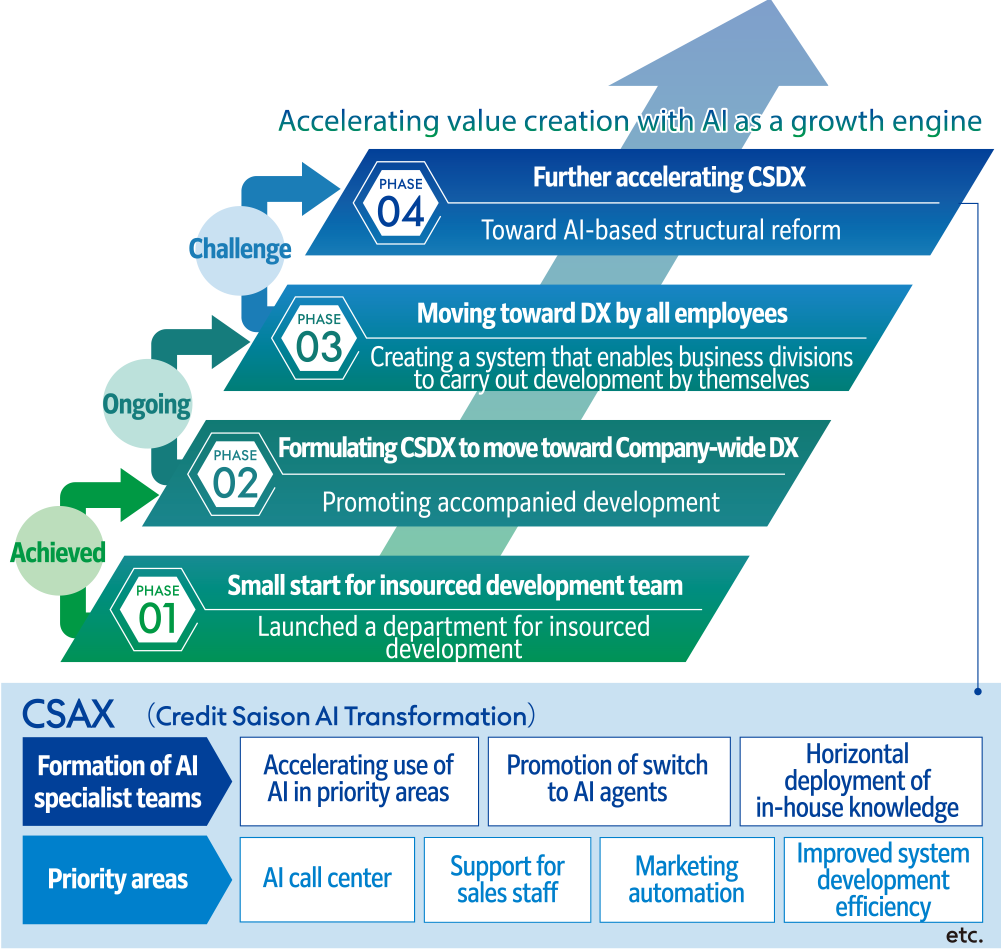
Since launching the Technology Center that is our in-house development organization in 2019, we have been formulating a CSDX strategy—with the aim of creating new experiences for customers (CX: Customer Experience) and transforming the experience for employees (EX: Employee Experience)—while working to promote DX.
In FY2024, the CSDX strategy will enter Phase 3. Having worked toward the complete digitalization of business processes, we have achieved a reduction of 1.61 million work hours (cumulative total from FY2019 to FY2024) and a reduction of 102 tons of paper (compared with FY2019).
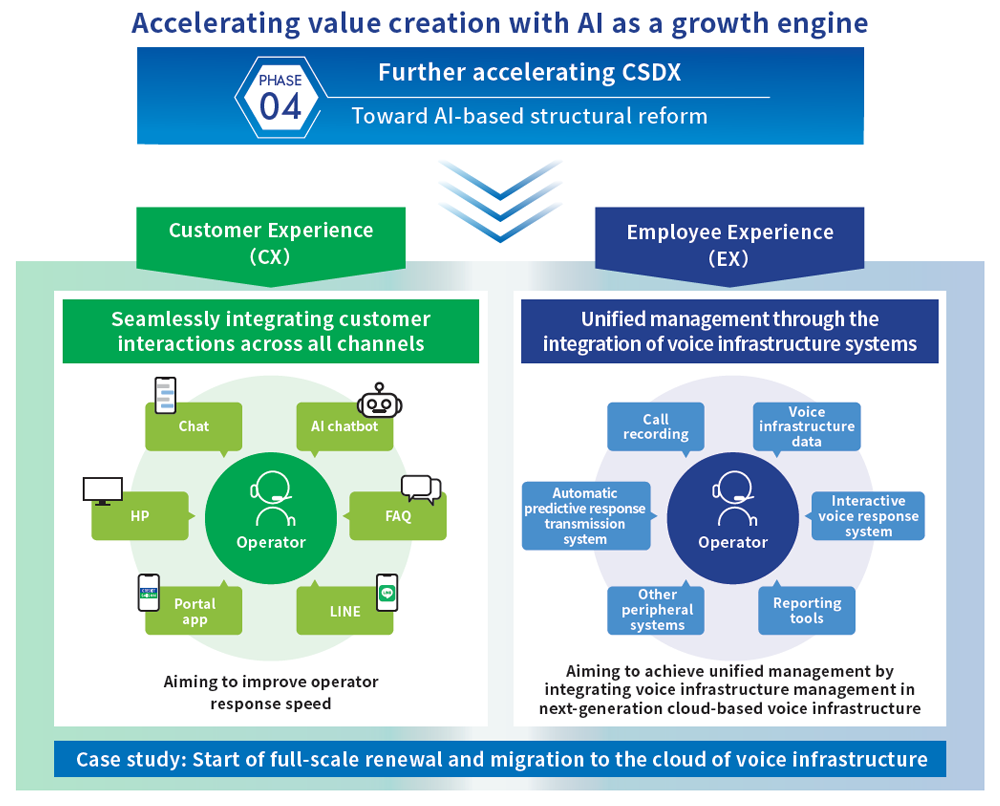
In FY2025, we will advance our CSDX strategy to Phase 4 and accelerate value creation with AI as a growth engine. We have been working to improve Employee Experience (EX), and case studies of our AI utilization to date include the in-house development of our own ChatGPT specifically for internal purposes, an in-house Slack chatbot for inquiries, and a system that prepares minutes of meetings.
To take this to the next level, we will work to bring in-house the voice infrastructure systems that support our call center operations, which represent the closest point of contact with our customers, to seamlessly consolidate customer interactions from all channels. In parallel with those efforts, we will focus on achieving results that are even more practical by installing advanced generative AI technology.
Toward Business Transformation through AI
Launch of the CSAX Project to Promote Generative AI
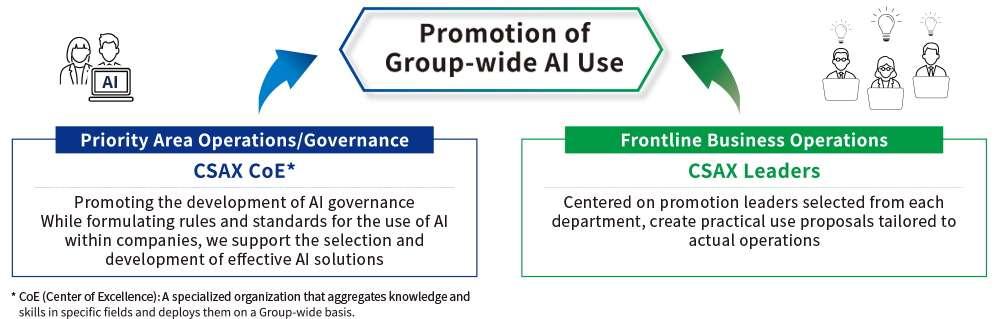
To promote the Group-wide use of generative AI, we launched the Generative AI Promotion Project in April 2025. This project is pursuing two approaches: a top-down approach to accelerate the introduction of AI in priority areas and a bottom-up approach to promote its frontline-driven use.
First, in introducing AI into priority areas, the in-house development department and the AI secretariat are working together to reform business processes across the organization. In consultation with management, we will promote the transition to generative AI-based operations in selected areas. We will also put in place security rules and create an environment in which AI can be utilized both safely and securely. In the meantime, in promoting the bottom-up, frontline-led utilization of AI, leaders selected from each department will implement cases suited to their work with the goal of solving issues in their own departments. The AI secretariat will collect these and turn particularly effective initiatives into templates for horizontal deployment. The plan is to also hold learning content sessions and hackathons tailored to the necessary knowledge and skills to help improve skills and foster a culture of AI utilization.
By promoting AI from both top-down and bottom-up perspectives, we will work to place AI at the core of our corporate transformation and achieve sustainable growth.
Enabling All Employees to Become AI Workers
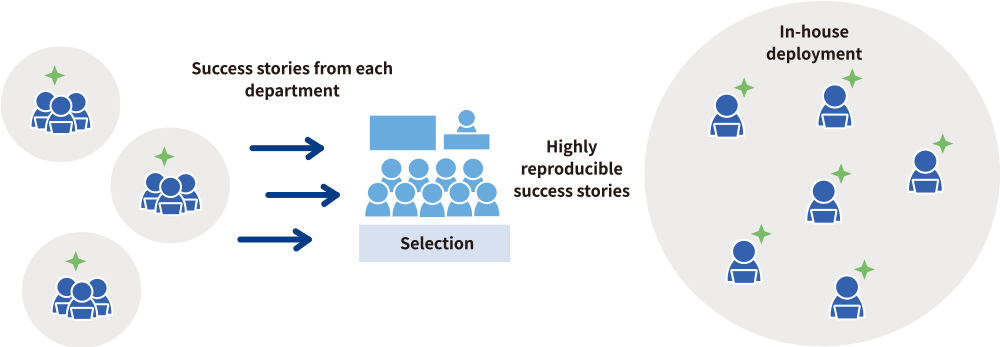
To strengthen the bottom-up promotion system, we will develop new initiatives to further deepen AI utilization on the front line and instill its use throughout the organization. Until now, generative AI tools have often only been used to improve work efficiency at the individual level, and there have been problems caused by the difficulties in utilizing such tools on a team basis or in deploying the lessons from superior case studies across an entire company.
We will therefore introduce a new generative AI workshop for small teams and build a system to consolidate individual know-how into common use cases. Specifically, each team will target the work of their own department and go through a cycle of planning → implementation → verification for a period of one to several months. From these initiatives, the AI secretariat will select projects that will be highly effective in reducing time and highly reproducible as success stories that can be deployed across the organization. Such projects will then be made into templates and deployed in-house.
In this way, by means of team collaboration and standardization, we will systematize the use of generative AI that had previously been scattered on an individual basis, thereby bringing about improvements in productivity across the entire organization.