Policy
We comply with the many different laws relating to human rights in the countries in which we do business. We understand and support international norms such as the Universal Declaration of Human Rights, the International Bill of Human Rights and the ILO Declaration on Fundamental Principles and Rights at Work and we respect basic human rights. Also, our business activities are in accordance with the UN Guiding Principles on Business and Human Rights.
Structure
Our company’s human rights initiatives are overseen by the Sustainability department, in collaboration with various business divisions, the Strategic Human Resources Department, the Risk Management Division, and labor unions.
The overall plan for human rights initiatives and identified key human rights risks are reported to and discussed by the Sustainability Promotion committee, chaired by the Director, Senior Managing Executive Officer overseeing the Global Business and the Sustainability Department. Where necessary, reports are also made to the Board of Directors.
Human Rights Due Diligence Initiatives
Based on our human rights policy, we recognize the importance of promoting human rights initiatives that align with international standards, including the UN Guiding Principles on Business and Human Rights, in order to fulfill our corporate responsibility to respect human rights.
With reference to these international standards, we are advancing our human rights due diligence efforts.
Human Rights Risk Assessment
FY2025, we have identified potential human rights risks in our payment and global businesses by examining the scope of our impact on human rights.
In addition to reviewing our human rights-related policies, documents, and records, we worked with external human rights experts to identify and organize potential human rights risks for each group of affected rights-holders, based on insights gathered through dialogue with our business divisions, the Strategic Human Resources Department, the labor union, and other stakeholders.
We then assessed each risk from two perspectives: severity (the seriousness of the impact on human rights if the risk materializes) and likelihood (the probability that the risk will materialize). Based on this assessment, we reported the results to the Board of Directors and determined our future approach to the priority issues.
We will continue to review and update our human rights risk assessments as part of our ongoing human rights due diligence process.
<FY2025 Risk Map>
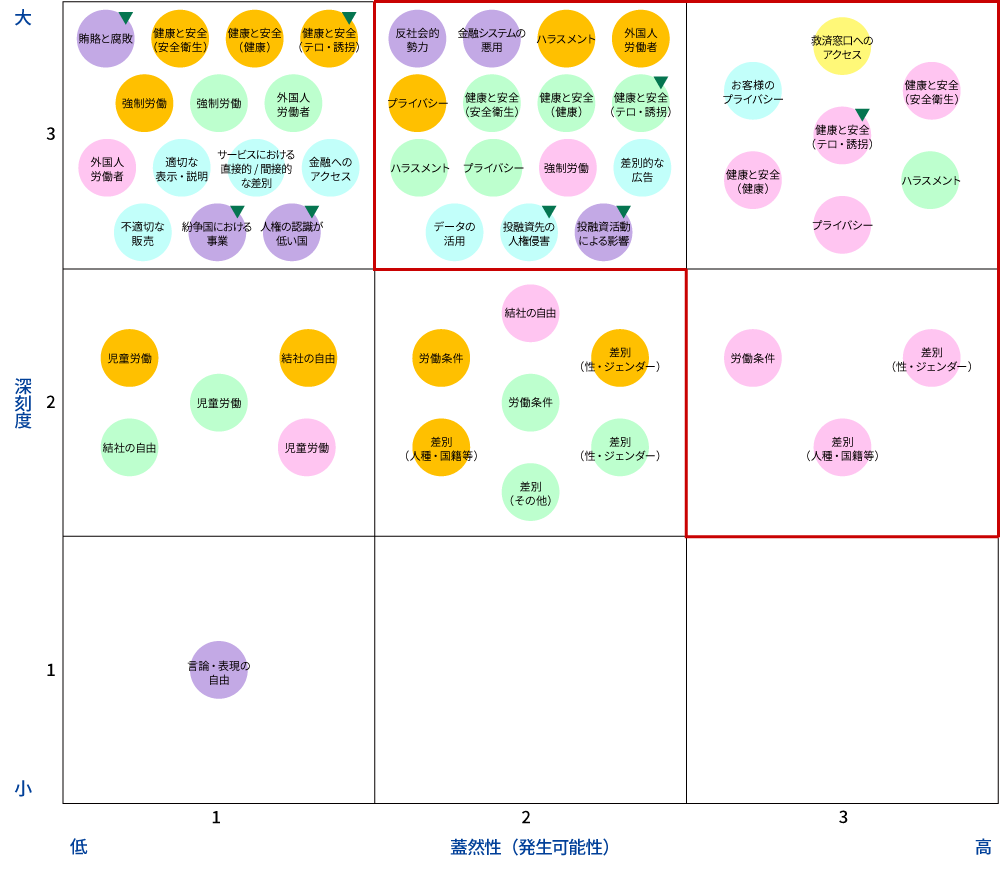
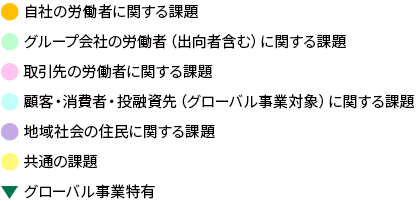
<Identified Priority Issues>
| Human Rights Risk | Affected Rights-holders |
|---|---|
| Health and Safety (health, occupational safety and hygiene, terrorism and kidnapping) | Group companies, business partners |
| Discrimination and Harassment | The company, group companies, business partners |
| Infringement of Privacy | The company, group companies, business partners, customers |
| Discriminatory Advertising | Customers |
| Use of Data | Customers |
| Human Rights Violations Related to Investment and Financing Activities | Investees/borrowers, local communities |
| Human Rights Violations through Financial Services | Local communities |
Identified issues, etc.
As a result of the human rights risk assessment conducted through dialogue with various business departments, the Strategic Human Resources Department, the labor union, etc., no severe human rights risks that would immediately materialize were identified. On the other hand, to minimize potential human rights risks, we have identified the following primary matters as priority issues that should be further strengthened and expanded in the future.
- ■ Data utilization: "Data utilization" is an element that forms the foundation of our future business. We will continuously consider the impact that data utilization itself, not limited to AI, may have on vulnerable people.
- ■ Human rights violations related to investment and lending activities: Human rights violations at investees and borrowers are recognized as a significant risk throughout the financial industry. We have already implemented scoring, etc. for impact investees and borrowers, and we will continue to consider strengthening and expanding these efforts.
Dialogue with Stakeholders
We conduct reviews by external legal counsel on the impacts of our business activities on human rights efforts and identify priority issues.
Going forward, we will continue to engage with a wide range of stakeholders and further enhance our human rights due diligence.
Corrective and remedial measures (establishment of Reporting system)
In accordance with the Whistleblower Protection Act, our group has established an internal whistleblowing system.
Of the 52 reports received through the internal reporting system in FY2025, 35 cases were related to human rights issues such as harassment and labor management.
There were no serious compliance violations related to human rights.
* For details, please refer to the "Internal Whistleblowing System" on the "Compliance" page below.
Internal Training
■ Prohibition of Harassment
Our work rules stipulate provisions on harassment, including disciplinary measures. We appoint compliance officers and compliance representatives in each department, and provide harassment awareness training as part of company-wide compliance training for all employees. We also deliver additional training and education tailored to specific employee levels.
■ Towards Eliminating Unconscious Bias
As part of our commitment to respecting human rights, we aim to foster an inclusive workplace culture that embraces diversity. To build a strong foundation for advancing DE&I, we provide training to deepen employees’ understanding of unconscious bias (unconscious assumptions and stereotypes).